Paper punch cards are still everywhere because they work. They are cheap, instant, and customers understand them on sight. But for most small shops in 2026, a loyalty app for small business now wins on almost every dimension that matters — and not for the reasons you would expect.
This is the honest comparison, including the places where punch cards still hold up.
Where punch cards still win
Paper cards are zero-friction at the counter. No app to open, no QR to scan, no signal needed. For a kiosk doing 200 transactions an hour, the speed matters. They also cost almost nothing to print, which is real money when you are pre-revenue.
If your business is a single location with one product and you only need to count visits, a punch card is fine. Do not let anyone shame you out of it.
Where punch cards break down
The cracks show up fast as you grow:
- Lost cards — customers stop coming back when they lose progress
- Counterfeit stamps — anyone with the right pen can cheat
- No customer list — when a regular stops coming, you cannot reach them
- No birthdays — the highest-ROI reward in loyalty is impossible
- No multi-branch — every location reinvents the wheel
- No data — you cannot tell who your top 20 customers actually are
That last point is the killer. The whole reason to run a loyalty rewards program for small business is to learn who your regulars are. A punch card gives the customer a reward but gives the owner nothing back.
Where a loyalty app wins
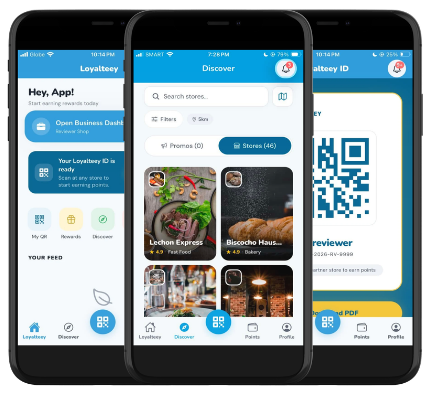
A good loyalty app captures the customer identity once and remembers everything after. The owner sees a real suki list. The customer never loses their stamps because they live in their phone. Birthdays fire automatically. Multi-branch owners can recognize the same customer across stores.
The friction at the counter is real — opening an app takes longer than handing over a card — but it has shrunk dramatically. With a saved QR on the lock screen, most customers can scan in under three seconds.
The honest middle ground
If you are nervous about switching, run both for a month. Keep your paper cards for walk-ins who refuse. Offer the app for everyone else and let the data convince you. Within four weeks you will see which customers chose the app — and they will almost always be your higher-frequency regulars.
A barbershop owner we know did exactly this. He kept his stamped cards on the counter for a month after launching his app. By week three, 70% of new sign-ups were on the app, his weekend regulars had all switched, and he had captured 40 birthdays he never had before. The paper cards quietly retired themselves.
What to look for in a loyalty app
- Free starting tier so you can test without commitment
- Per-store points so giving away a free item at your shop does not get cashed at someone else's
- Birthday rewards built in
- Works without a POS integration
- One app for both customer and owner
The Loyalteey app covers all of those out of the box. Customers use one QR to earn at any participating store, and owners run the whole loyalty rewards program for small business from the same app in business mode. It is the easiest way to leave punch cards behind without rebuilding your checkout.